 Steakhouse.lu
Beef cuts
Which cut
sits where?
A grown steer yields around 300 kilograms of usable meat, spread across some 25 primal cuts. Only a quarter of that is steak material in the narrow sense. This map shows where those pieces sit, what they are called in three languages and how much heat they can take.
Click a section · Tab and Enter work too
Hindquarter · 2–5 % fat
Round
Four large muscle groups: topside, silverside, knuckle and the adjoining rump. They carry a lot of weight over the animal's life and are accordingly firm and lean. Only a few muscles from here are suited to quick searing.
Best method: very hot and very short, or the opposite — braise it for hours. Everything in between turns tough.
Hindquarter · 4–8 % fat
Rump / top sirloin
The transition from the loin to the round. The rump combines a fine-grained core with a substantial fat cap — and the entire reputation of the picanha rests on that cap.
Best method: grill the whole piece fat side first, then finish it indirectly and slice against the grain.
Rear back · 6–12 % fat
Short loin / striploin
The back muscle between the rib and the rump, with the tenderloin running underneath it. Firm bite, even grain, a broad fat edge along the top — the classic European steak cut.
Best method: score the fat edge, render it on the fat side first, then sear hard on both faces.
Front back · 10–20 % fat
Rib
The rib section from the 6th to the 12th rib. Three muscles converge here, and between them lies the characteristic eye of fat. No other primal is as heavily marbled.
Best method: the rib handles high heat without trouble — the intramuscular fat protects it from drying out.
Forequarter · 5–12 % fat
Chuck & shoulder
A web of more than twenty muscles. Most of them are braising meat, but two exceptions — flat iron and teres major — are among the tenderest and cheapest steak cuts there are.
Best method: on the flat iron, remove the central sinew without fail, then sear it like a striploin.
Forequarter · 8–15 % fat
Neck
Heavily shot through with connective tissue and seams of fat. Cooked slowly, the collagen dissolves into gelatine — which is why neck is the best cut for goulash and pulled beef, and yields the juiciest burger mince.
Best method: braise for at least three hours at 90–95 °C.
Belly · 6–10 % fat
Flank
A flat, wide muscle with strikingly long, straight fibres. It delivers one of the most intense beef aromas there is — but insists on being sliced thinly and against the grain.
Best method: marinate, grill very hot, keep it at medium rare, rest for ten minutes, then slice at a 45-degree angle.
Belly · 10–18 % fat
Short plate
The rib belly between brisket and flank. This is where the cuts sit that American butchers used to keep for themselves: skirt, hanger and the short ribs.
Best method: skirt and hanger very hot and very short; short ribs, by contrast, for hours at a low temperature.
Forequarter · 12–20 % fat
Brisket
Two muscles, the lean flat and the fatty point, separated by a thick layer of fat. As brisket it is the most important cut in Texan barbecue; in Europe it was traditionally boiling beef.
Best method: 10 to 14 hours at 110 °C to a core temperature of 92–95 °C.
Under the loin · 2–4 % fat
Tenderloin
The psoas major lies protected along the inside of the spine and carries no load at all. Hence the fine grain and the tenderness — but it is so lean that it brings little flavour of its own.
Best method: sear high and short, then let it come up in a 120 °C oven; never past medium.
Reference
Every steak cut at a glance
The same piece of muscle often goes by entirely different names in Luxembourg, France, Germany and the United States — and sometimes the same name refers to two different cuts. This table lines the common terms up against each other.
| Cut | French | German | Primal | Portion | Method |
|---|---|---|---|---|---|
| Ribeye | Entrecôte | Entrecôte | Rib | 250–350 g | Quick sear |
| Bone-in ribeye | Côte de bœuf | Côte de Bœuf | Rib | 700–1200 g | Reverse sear |
| Tomahawk | Côte à l'os longue | Tomahawk | Rib | 1000–1600 g | Reverse sear |
| Rib cap / spinalis | Calotte | Rib Cap | Rib | 150–250 g | Quick sear |
| Striploin / NY strip | Contre-filet | Rumpsteak | Short loin | 220–320 g | Quick sear |
| T-bone | T-bone | T-Bone | Short loin + tenderloin | 600–800 g | Reverse sear |
| Porterhouse | Porterhouse | Porterhouse | Short loin + tenderloin | 800–1400 g | Reverse sear |
| Tenderloin head | Chateaubriand | Chateaubriand | Tenderloin | 400–600 g | Sear & oven |
| Filet mignon | Tournedos | Tournedos | Tenderloin | 160–220 g | Quick sear |
| Top sirloin cap | Rumsteck / culotte | Picanha | Rump | 1000–1500 g | Grill / rodizio |
| Tri-tip | Aiguillette baronne | Tri-Tip | Rump | 700–1200 g | Reverse sear |
| Sirloin steak | Rumsteck | Hüftsteak | Rump | 200–280 g | Quick sear |
| Spider steak | Araignée | Bürgermeisterstück | Round | 400–700 g | Quick sear |
| Flat iron / butler's steak | Macreuse à bifteck | Flat Iron | Chuck | 200–300 g | Quick sear |
| Petite tender | Jumeau | Teres Major | Chuck | 300–500 g | Quick sear |
| Denver steak | Basses côtes | Denver Cut | Neck | 200–300 g | Quick sear |
| Flank steak | Bavette de flanchet | Flanksteak | Flank | 600–1000 g | Grill, slice thin |
| Flap meat | Bavette d'aloyau | Bavette | Flank | 400–800 g | Grill, slice thin |
| Skirt steak | Hampe | Skirt Steak | Short plate | 300–500 g | Very hot, very short |
| Hanger steak | Onglet | Onglet | Short plate | 300–500 g | Very hot, very short |
| Short ribs | Plat de côtes | Short Ribs | Short plate | 800–1500 g | Braise / smoke |
| Brisket | Poitrine | Brust | Brisket | 3000–6000 g | Low & slow |
| Shank / osso buco | Jarret | Beinscheibe | Shank | 300–500 g | Braise |
Portion sizes refer to standard retail cuts. Weights vary considerably by breed, age and butcher.
Rib: ribeye, entrecôte and tomahawk
The rib runs from the sixth to the twelfth rib. What sets it apart is the combination of three muscles: the large back muscle (longissimus dorsi), the cap lying over it (spinalis dorsi) and the small complexus. Between them sits the famous eye of fat — the core of fat that gave the ribeye its name.
That very fat is what makes the cut so forgiving: where a tenderloin turns dry two degrees past the mark, here rising temperature melts fat between the fibres. If you are unsure of hitting the point, start with ribeye rather than fillet.
Entrecôte or ribeye — is there a difference?
At heart both names describe the same cut, only from two butchering traditions. The French entrecôte is usually cut a little thinner and comes from the front section; the American ribeye is often thicker and cut with a larger share of the cap. On Luxembourgish restaurant menus both terms sit side by side and in practice mean the same thing.
The tomahawk
A ribeye with the rib bone frenched to 15 or 30 centimetres. The long bone adds nothing in the kitchen and everything on the plate — which is why it is the classic for a table of two. One caveat: at five to seven centimetres thick, the tomahawk only works with an indirect pre-cooking phase, otherwise the crust is black before the core is warm.
The best bite on the whole animal
If you ask your butcher whether he can trim out the rib cap (French calotte, Latin spinalis) separately, you get the cap muscle of the rib as a cut of its own. It combines the marbling of a ribeye with a tenderness close to fillet. Many butchers grind it into mince, because almost nobody asks for it.
Short loin: striploin, T-bone, porterhouse
Behind the rib the back muscle continues and grows leaner. This is the short loin — in France contre-filet, in the United States strip loin. Its signature features are the broad fat cap along the top and a distinctly firmer grain than the ribeye. If you like a steak with bite, this is your cut.
Do not trim the fat edge off; instead score it every two centimetres almost down to the meat. That stops the steak from curling in the pan, and the rendered fat becomes your cooking fat.
T-bone and porterhouse
Cut the short loin crosswise through the vertebra and you get the back muscle on one side of the T-shaped bone and the tenderloin on the other. The only difference between the two cuts is the size of the tenderloin: on a T-bone it measures less than about five centimetres, on a porterhouse more. The porterhouse therefore comes from further back, where the tenderloin gets thicker.
A practical problem: two muscles with different fat contents on one bone will never finish at the same moment. Lay the steak on the grill so the tenderloin points towards the cooler zone.
Tenderloin: the tenderest, not the best
The tenderloin lies on the inside of the lumbar spine and is barely used when the animal walks. Without load the muscle forms little connective tissue — hence the proverbial tenderness. The price for it: at two to four per cent fat, the tenderloin lacks what carries flavour.
Three sections are cut from the whole tenderloin: the thick head (chateaubriand, traditionally for two), the even centre (tournedos, filet mignon) and the tapering tail (medallions, fondue, stroganoff). A whole tenderloin weighs between 1.8 and 3 kilograms depending on breed.
Because the flavour of its own is muted, classical cooking works here with companions: a bacon wrap, herb butter, béarnaise or a red wine jus. Eating fillet without a sauce wastes it.
Rump: picanha and tri-tip
The rump adjoins the short loin at the back. In South America, this is where steak culture really begins: the picanha — the rump cap with a one- to two-centimetre fat layer — is the signature cut of every Brazilian rodizio. It is grilled whole or bent into a C on a skewer, fat side towards the embers, with the cooked outer layers carved off in stages.
The tri-tip comes from the lower rump and became a cult cut in California. It is triangular, has two different grain directions and therefore has to be sliced in two stages.
Both cuts want the same treatment: coarse sea salt, nothing else, and slicing strictly against the grain.
Round: lean, cheap, underrated
Topside, silverside, knuckle and rump make up the hindquarter. Little of it is suitable for steak in the classic sense — with one exception: the spider steak, French araignée ("spider") after its web-like fat pattern. It is a small, well-marbled muscle on the inside of the rump and surprisingly tender.
The rest of the round goes into roulades, roasts, fondue or — sliced paper-thin against the grain — into carpaccio and tartare. The shank becomes osso buco and the basis for powerful stocks.
Chuck and shoulder: where the insider picks are
The shoulder is a web of more than twenty muscles. Two of them are worth hunting down:
- Flat iron (top blade, macreuse à bifteck) — the second tenderest muscle on the animal after the tenderloin, though it runs through a substantial central sinew. Remove it and two perfect flat steaks are left.
- Teres major ("butcher's tenderloin", petite tender) — a small, spindle-shaped muscle that recalls a fillet in shape and texture but has considerably more flavour of its own.
The Denver cut from the neck end is the third candidate: heavily marbled, powerful in aroma, but only genuinely tender up to medium rare.
Flank: aroma instead of tenderness
Flank steak and bavette are coarse-grained, lean and intensely flavoured. In Argentina, Mexico and France they have long been classics; in German-speaking countries they were sold as boiling beef for decades.
The rule for both cuts: do not cook past medium rare, rest for at least ten minutes and then slice as thinly as possible against the grain. Slice with the grain and you get chewing gum — regardless of the quality of the meat.
Short plate: skirt, hanger and short ribs
The rib belly delivers the most aromatic cuts on the animal. The skirt steak (French hampe) is the diaphragm muscle and is traditionally used for fajitas: two minutes per side at maximum heat, no more.
The hanger steak or onglet hangs freely between the kidneys. There is only one per animal, which is why butchers used to keep it for themselves — hence the name butcher's steak. It has a thick central sinew that must be removed before cooking.
Short ribs go the opposite way: eight hours at 110 °C, until the collagen gels and the meat falls off the bone.
Brisket
The brisket consists of two muscles — the lean flat and the fatty point, separated by a thick layer of fat. It was always known in Europe as boiling beef, but it owes its fame to Texan barbecue: 10 to 14 hours in smoke at 110 °C, until the core reaches 92 to 95 °C.
The point yields the burnt ends: diced, glazed again and returned to the smoke for a second round.
Neck and chuck roll
The neck works constantly and is correspondingly laced with connective tissue. It is no use for quick searing — but anyone making goulash, ragout or pulled beef will find the best raw material here. Neck is also first choice for burger mince: at around 20 per cent fat the patty stays juicy without falling apart.
There is one exception: the chuck eye steak, right where the neck meets the rib. It comes from the same muscle strand as the ribeye and is therefore also called the "poor man's ribeye" — at roughly half the price.
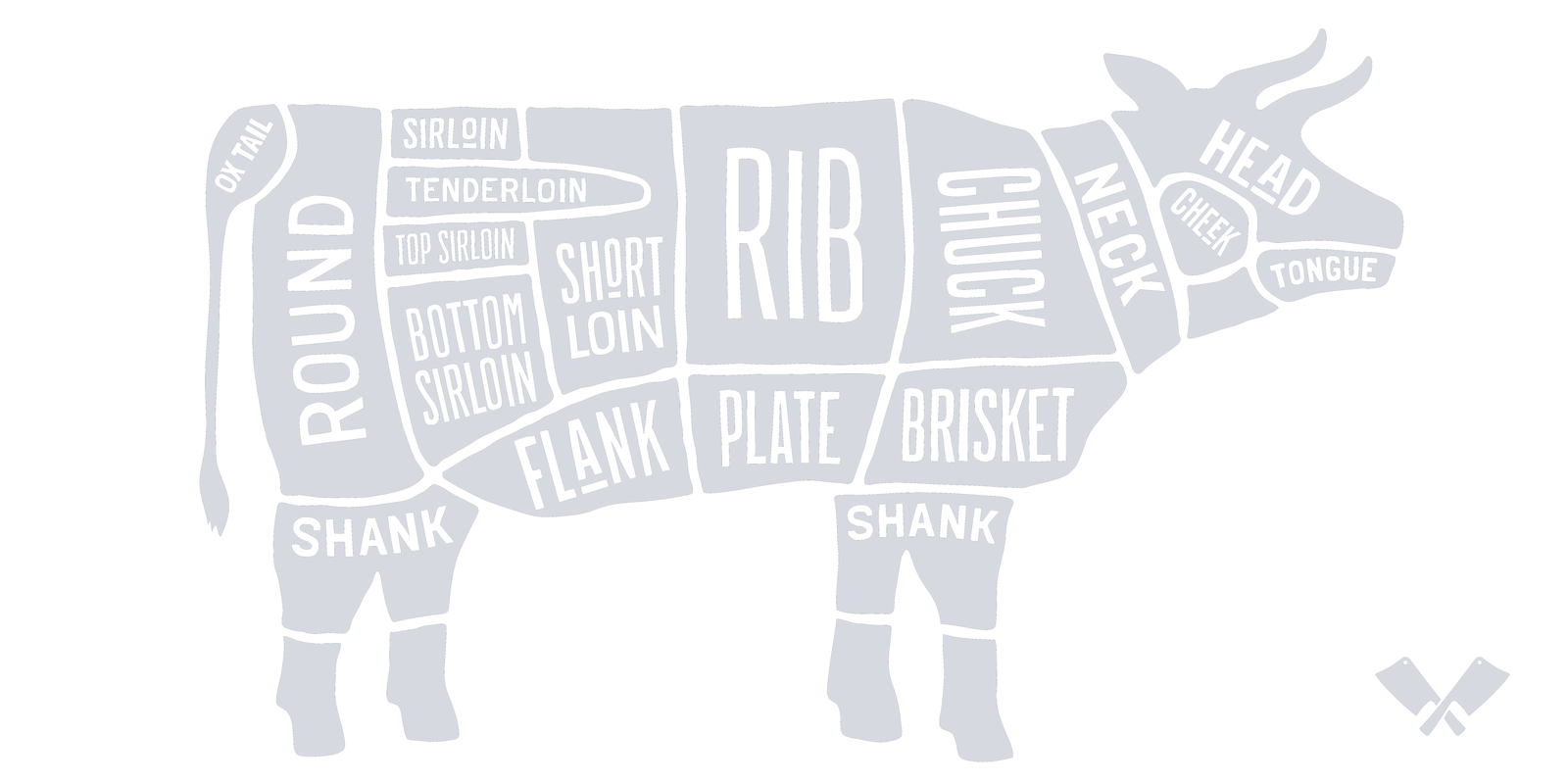
European and American butchering
The most important difference lies in the direction of the cut: European butchers separate along the natural boundaries between muscles, while American butchers first break the animal down into eight large primal cuts and then saw straight through several muscles at once. That is why the United States has cuts like the T-bone and the porterhouse, which run through bone and two muscles — in a classical French breakdown they would never arise.
In practice this means: if you want to order an American cut from your butcher, bring along the information about which primal it comes from. Not everyone knows "flat iron", but "the top blade with the central sinew removed" gets you there.
Read on
And how is it cooked?
Every cut has its method. From the cast-iron pan through reverse sear to sous vide — with temperatures, times and the most common mistakes.
Beef cut sheet
The map of the animal with every cut in English, French and German.